Sunday, November 11, 2018

Abydos Field Trip, Take 2


On Friday, rather than having a bit of a lie in and catching up on sleep, we instead awoke an extra hour early to be collected by 5:10 am as part Hazem’s very tightly coordinated schedule of collecting everyone at designated times on both the east and west banks. Amazingly, all were at their points close enough to time so that we met Hazem’s demanding schedule and were leaving Luxor for the desert road around 6 am! Thanks to the fact that we were travelling with our Egyptian students we were able to take the shorter desert route, which is ordinarily forbidden to foreigners, and reduces the journey to Abydos by at least an hour. A third of the way into the journey, Sayed opened up the snack box, and juices and chocolate biscuits were disseminated through the bus. Those who had been able to get a few winks of sleep prior to this, were the lucky ones, because now everyone was wide awake! Thanks to the desert route we arrived via the back way to Abydos, meandering through the cemeteries on the edge of the settlement, and though the driver had no idea where we were going, thanks to Yaser’s local knowledge we did not get lost! Amazingly, we could soon see the back of the temple and rounded the great court to reach the small Egyptian café where we had eaten breakfast a year ago. It was a kind of time warp, as all seemed unchanged, with our table waiting, and within minutes we had spread out and fully occupied the café’s streetside terrace. Orders were quickly placed and the food began to appear as if by magic, though seeing as we were so many the food tended to appear in fits and starts, with the head of the table doing far better out of the arrangement. But all eventually had fuul mixed with zibda (butter), salat, the local specialty of omelets fried in metal bowls and still sizzling when they came to the table, bread, and of course the infamous mish made its appearance. As previously, there was not enough bread, and cries of “aish tani” (more bread) rang repeatedly, particularly from the end of the table, who continually seemed to have not enough food. Bread had to be sent for from a nearby bakery, and needless to say by the time it arrived we had already drunk our post-meal tea and coffee and were heading out, piling back into the bus and making our way to the temple of Ramesses II. It was decided that since the temple is mostly open to the air, to visit it first in the cool of the day, and to save the larger Seti I temple, for the most part roofed, for last.

The view of the Seti I Temple from breakfast 


After a drive of a matter of minutes, we were dropped in front of the temple, and the floor so to speak was handed to Yaser to give an introduction to the temple in Arabic to the students. We are truly fortunate to have Yaser, as he is able to speak knowledgably about the site of Abydos as he has known and loved it for his entire professional life, and he clearly communicates his passion and enthusiasm whenever he talks about any aspect of Abydos and its history. He moved the students through the temple, recounting its architectural history, and seamlessly passing them to Hassan Ramadan, who then gave an explanation of the digital epigraphy that he had employed while recording the temple. Hassan made excellent use of one of the carved and painted rear rooms to not only demonstrate but describe the different digital approaches one might take to record what was a very complicated wall. Our students did us proud by not only listening intently and taking notes, but also peppering Hassan with questions which led to even further dialogue and discussions. Although not fully understanding the Arabic, we felt that it had turned into a truly excellent teaching experience. And unbelievably it took nearly an hour before our students had run out of questions! At that point, the local inspector Hazem Salah, an old friend and former student of Will’s, joined us for the remainder of the tour, which facilitated access to parts of the site normally closed to the public. We were now able to take a short cut across the desert to reach the back of the Seti temple, and particularly the Osirieon. As with the Ramesses II temple, Yaser and also Hazem Salah introduced the students to the importance of the Osirieon and its relationship to the temple itself. Following their excellent presentation, the men needed to go to the mosque for Friday prayer, leaving the rest, including Will and JJ, to then spend some extra time in the Seti temple to explore and enjoy the deep cool shade created by the vaulted chapels at the rear of the temple.


After prayers, the group reformed in the Seti temple, with Hazem Saleh giving an impromptu tour of the temple for our students. And by 1pm, on schedule, we were able to again leave by the back of the temple to take the short cut across the desert to he small home and restaurant near the Ramesses II temple where we would have lunch. Those of you who remember our blog about Abydos from last year, will not be surprised that we returned to the same venue where we had had such a wonderful meal before and had proved such a pleasant place for our students to relax after their epigraphic exertions! The food was forthcoming almost immediately, though it took us some time to figure out our seating arrangements, which somehow reverted to a boys table, and a girls table (we just cant win!). Lentil soup was followed by mounds of rice, chicken, homemade kofta, and vegetable tagines, and as before the meal was rounded off by the legendary Abydene bananas, which though small truly are the most delicious bananas in Egypt!

Yaser and Abydos Inspector Hazem Saleh


 Group photo on the steps at the rear of the Seti I Temple

Hazem Saleh talking to the students about the temple


Abydene Banana!

Will and Hassan Ramadan

This occasion was somewhat different than in the past because it was to be our last meal with two of our students, Rasha and Alaa Talaat who we were leaving in Abydos to join the American mission directed by Dr. Janet Richards. Seeing as they would not be able to join us for graduation, we brought graduation to them, presenting them with the personal drawing boards and gift mugs, as you will remember we did earlier in the season for Ahmed ElNasseh when he likewise had to leave us for pastures anew. As with Ahmed joining a French excavation in Saudi Arabia, working with Janet would be an excellent opportunity for Alaa Talaat and Rasha to gain additional epigraphic experience, and it was also a reunion of sorts for JJ, who had cut her teeth some 20 years ago working with Janet at Abydos. When the car carrying Janet arrived at the restaurant, it was a wonderful reunion, as not only did Janet come, but also the Abydos house manager Ahmed Ragab and one of the house staff, Sinjab, whom JJ had not seen in many years. Much time was spent chatting and catching up, and of course introducing Janet to our team and our students, some of whom, like Yaser, she knew very well. But eventually it was time to leave, and after the usual lengthy and emotional Egyptian farewells, our students piled into the bus bidding Alaa Talaat and Rasha goodbye, and wishing them luck in their work at Abydos. As we drove off in one direction, they drive off in the opposite heading up the wadi to the American dig house.


Unfortunately, now that our presence was well known at the temple, we were provided with a military escort back through the city of Baliana, and it was some time before we could return to the desert road to make our journey home to Luxor. Despite the long day, or perhaps because of it, our students found unexpected reserves of energy for an unbelievably boisterous journey back, with much hilarity originating in the back of the bus (no surprise there). By the time we reached Luxor, dusk and then night had settled over the west as we recognized familiar landmarks, and one-by-one our students were deposited by the side of the road to make their way to their various homes. It was nearly 6pm by the time Hassan Ramadan departed and Will and JJ were returned to their flat, with Hazem handling the cleaning and returning of the bus. A long but successful day with the realization that we all had to be up early again the next morning to return to work. Unbelievably the long anticipated field trip was now a pleasant memory.


Arrival back in Luxor

Thursday, November 8, 2018

Field School Week 3

On Saturday we returned to the West Bank and the students returned to working in their assigned research tombs, carrying on with the research steps, comparing and contrasting the tomb walls with the published material. We left them to it, only checking in briefly to be sure everything was clear.  At breakfast we were joined both by our former student Mahmoud Hassan, and by our friend and colleague Hratch Parpazian from Cambridge University. Despite the trek across the desert, Hratch arrived laden with not just Egyptian sweets, but chilled sweets, having had the foresight to pack his rucksack with ice! We had already arranged that our former student Mahmoud Hassan, who is working in a nearby tomb, be available to demonstrate to the students the program he had created the previous year to document his tomb. Mahmoud generously offered to show the students his work after the breakfast. This was an excellent opportunity for the students to have reinforced what they had learned from their work in TT110 and TT41. While Mahmoud took our students to his tomb, we brought Hratch over to TT110 and gave him a tour of the tomb and our work in it. And following Mahmoud’s presentation, the students went back to working in their tombs for the rest of the work day.

JJ and Will with Hratch

 Mahmoud Hassan presenting his work

Sunday continued in very much the same fashion, with the students in their tombs until breakfast, when we had unexpected guests. We were delighted that our former students Rasha and Abu el-Hagag had taken up our invitation to visit and joined us for breakfast. For Rasha, it was a chance to meet our new students, as she has been away from Luxor and Egypt living in Saudi Arabia with her husband and son. The reunion was made all the more delightful as Rasha brought both cakes and Egyptian sweets, along with cold soda! After breakfast, it was back to work for everyone, with the students wrapping their research projects and Will and JJ checking in to be sure each group would be ready to begin their presentations first thing Monday morning. While JJ and Will were checking on the students, Sayed and Hazem kept busy by preparing the students’ computers for the digital component of the field school, which was set to begin at the end of the week.


Monday morning brought the moment of truth for our students. In order to maximize the degree of communication in the presentations, we had insisted the students speak in Arabic because it was as much about the students presenting what they had learned as their colleagues learning from their experience. We decided to begin with the tomb furthest away, and involving not 2 but 3 of the students: the tomb of Ramose, TT55, which had been assigned to Mahmoud, Safaa, and Rasha. They did a marvelous job taking their fellow students and colleagues through the tomb, following the research steps and dividing the presentation up into equal parts, beginning in the courtyard where Safaa walked the students through the architecture, to Mahmoud in the tomb explaining the decorative history, and finishing with Rasha and the epigraphic analysis.


There was just enough time after the trek back and before breakfast for our Inspector Atito to explain to the students the research he had been doing in TT110. Since the students themselves knew the tomb so well, it was an excellent opportunity for Atito to benefit form their experience as well. Seeing as this was all entirely new to Atito, he did a very good job in applying the research steps and noticing many of the issues familiar to us from our work in the tomb. He also timed his presentation perfectly, finishing at exactly 10:30 in time for second breakfast!


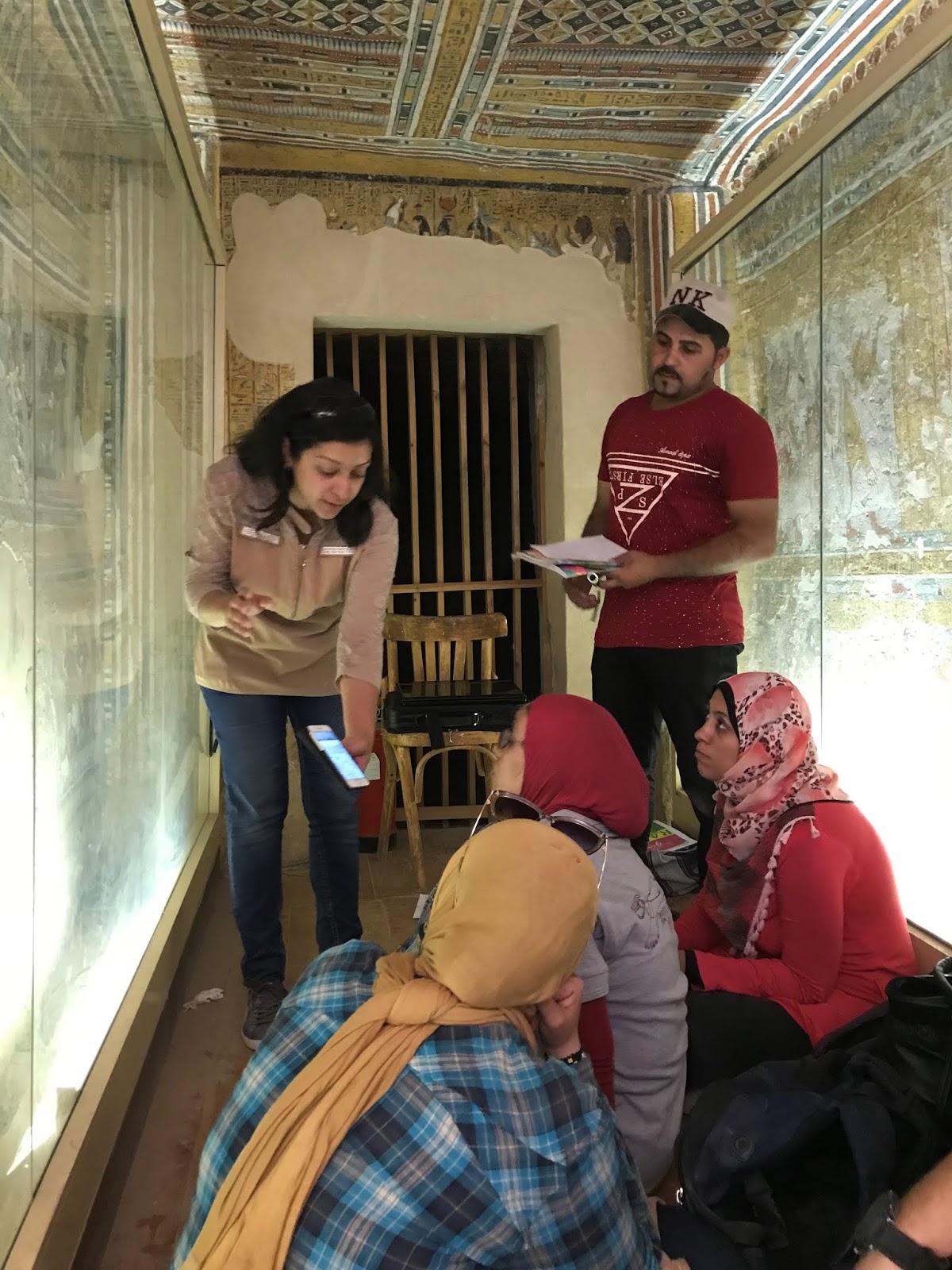
Second breakfast was probably enjoyed more by the students who had already completed their presentations, than the others who were still waiting to know who would be next. After breakfast, the presentations continued with Amira and Alaa Talaat taking us through their work in TT296, a very small, single-chamber, elaborately painted Ramesside tomb – quite the contrast to Ramose. Again, we were very impressed with their presentation and seeing as the tomb was so small, especially with all of us inside, their presentation necessarily became more of a dialogue with them sharing and commenting upon each other’s contribution, with Alaa Talaat taking the lead on the decorative program and Amira on the epigraphic analysis. 

An unexpected discovery!


We finished the day in good time, leaving the final two presentations for Tuesday morning. Monday afternoon found us back at Hazems for our weekly visit and home-cooked Egyptian meal, this time another of our favorites: mashi (rice-stuffed vegetables), which provided us with generous leftovers for home. 

The next morning, following tea and coffee, it was Rehab and Mina’s turn to present on their research in the beautifully painted tomb of Menna, TT69, another very small tomb. As with the day before, Mina and Rehab impressed us with their thorough analysis of the tomb’s decorative history, which was made all the more difficult by areas of re-working. Seeing as Menna is a well-known tomb that has been open to the public for over a century, they made excellent use of earlier photographs and publications, as well as referencing the most recent high-tech digital work in the tomb by Melinda Hartwig. 


We were more-or-less on schedule for the final presentation by Walid and Hala, with the understanding that second breakfast would be delayed slightly until they had finished. In a sense we had come full circle, and after 2 small painted tombs, we were once again in a large, carved tomb similar to Ramose, that of Kheruef, TT192. Walid and Hala did a superb job dividing up their presentation and walking us all through the tomb’s immense courtyards and spaces while drawing our attention to the tomb’s architectural and decorative program. They paid particular attention to the Chicago House publication, providing an excellent analysis of the earlier epigraphic program, and commenting upon how they might do it differently incorporating more recent technical advancements. 


Beam me up Scotty! 


With all the presentations complete, JJ and Mr. Will took the opportunity to review with the students each of their presentations and praise them for how successfully they had understood the research assignment in order to give varied and impressive presentations, incorporating not only printouts and photos from their research, but also computer illustrations. Seeing as this brought to a conclusion the first 2 weeks of the school with epigraphy programming and research, it seemed an ideal opportunity to take advantage of the grand staircase leading into Kheruef for a last group photo of what is clearly a happily relieved field school!


Seeing as we still had some time in hand, we delegated Hazem to take on the teaching role, giving the students a little bit of introduction to the setting up of their computers for the digital portion of the school which would start the next day with the arrival of the newly PhD’d (mabruk!) Dr. Hassan Ramadan.


Feeling pleased and proud, Will and JJ decided, with very little encouragement, to celebrate the successful beginning of the school by going to, guess where? Pizza Roma, for guess what? Cold beer!

With the arrival of Hassan Ramadan on Tuesday night, it meant that Wednesday morning found us not on the west, but back at Karnak Lab, behind the Khonsu Temple area of Karnak, where the students would be taught by Hassan for the remaining 2 weeks of the field school. It also meant that our student Hussein has returned to the field school for the digital portion. Since Hassan had successfully defended his PhD in Berlin less than a week before joining us in Egypt, we wanted to acknowledge this accomplishment straightaway, with a cake for second breakfast. The cake was from Twinkies, the famous bakery by the railway station, but the distance from the site meant it had a rather convoluted arrival via taxi, our on-site helper Mostafa, to Hazem, and finally to Hassan Ramadan! Despite the lack of plates or cutlery, it was much enjoyed by all.


Tuesday and Wednesday were spent in much the same fashion, with Hassan beginning his teaching of which Illustrator tools would be the most useful for the kind of digital drawing the students would generally be doing. Seeing as Hazem and Sayed had gone to great lengths to prepare the students’ laptops, and the lab, in advance of Hassan’s arrival, Hassan was able to hit the ground running. And we found within a very short time the students were all working with very intense concentration, without anyone seeming to fall behind.


Alaa Talaat's first attempts ...


As with the previous week, on Thursday we adjourned at the end of the work day to Pizza Roma for a staff meeting, now of course including Hassan. We were able to go over the completion of the research and presentations, bringing Hassan and Yaser up-to-date, as well as clarify and plan how the upcoming weeks would proceed. A quiet night in was obligatory, seeing as we will need to be up even earlier than usual to be collected for our field trip to Abydos on Friday, at 5:10 am! As in previous seasons, we will post a special blog about the day’s outing and subsequent adventures. So expect another report at the beginning of next week in order to keep up with us!