Thursday, February 22, 2018

Field School Week 2

Like always, we spent Friday working at home and at Chicago House, running errands, and finishing up the weekly blog. On Saturday we returned to the west bank, which will be our based of operations for the remainder of the school. The introductory courses and trips are now finished, and we can begin to start the real epigraphy teaching. Beginning in the morning, and after Abu Hamada and his young assistant Mohamed had cleared away the morning tea and coffee detritus, Mr. Will brought out the infamous “5 Epigraphy Steps”, of which no doubt the students had been hearing rumors from the friends in previous field schools. We spent the morning under the breakfast tent going painstakingly slowly through each step due to much useful discussion and clarification from Sayed and Hazem in Arabic. In light of the fact that we have taught this in two previous schools, we now better understand what needs to be gone over in more detail from the beginning. Insha’allah this will mean that there the students will move more quickly once they are really working in the tomb. So, it will have been time well spent. Mr. Will managed to make all 5 steps last until exactly 1pm, in time for our mass exodus via mini-bus. While all of this was happening in the breakfast tent, Yaser continued at the illustration tent, introducing his students to the principles of object drawing. Our Inspector Safaa, who had previously been learning pottery drawing with Yaser, has now joined the epigraphy portion of the school with Will and JJ.


When we arrived on site Sunday morning quite the sight greeted us - several balloons drifting low across the edge of the gebel, over the tomb. Although the sight of early morning balloons is not that unusual, we had never witnessed them so close to our work before - it was quite a surreal welcome. After tea and coffee we began the day by having a look at Alaa’s tomb (TT 108), located just below the illustration tent. As some of you might recall, we had consulted with Alaa in previous years about the epigraphy needing to be done in his tomb. So, we asked him to explain the work he had done to the students, including our returning illustration students. Once Alaa had finished, Mr. Will picked up the baton and explained how they would approach a tomb like Alaa’s before actually beginning to draw, looking at things like shape, condition, damage, decoration, etc. A kind of prequel to what we will introduce them to in TT110. Once again thanks to the many questions asked by our students, as with Saad, what we thought was going to be a short session took the entire morning. After the breakfast Yaser’s students returned to their illustration instruction and we took the students down to TT 110 where Will walked them through the tomb, focusing on the stone, nature of the restoration and conservation, ancient plaster remains, etc., so that the students could begin to understand the difficulty of drawing the tomb walls and learn what they will need to look for before beginning their own drawings.

Balloons over TT 110 

Alaa explaining his tomb to the students 


After the work had finished, Will, JJ, and Sayed stopped in at the New Memnon Hotel, just behind the west bank ARCE office, so that we could meet up with the MMA Malqata team. Over sodas and chipsies on the roof of the hotel, with a spectacular panorama view of the west bank, we chatted and caught up with the team, many of whom are old friends, including Susan Allen, Catharine Roehrig, Janice Kamrin, Jan Picton, as well as Piet Collet whom we had expected to have already left Luxor but had delayed his trip. We extended an invitation for them to visit our work, so hopefully we shall see them again at TT110. What was meant to be a short 20 minute stop turned into a lovely and leisurely extended conversation with many anecdotes and funny stories being exchanged, as is so often the case after Egyptologists get together after a long absence. Consequently, there was very little turn around between a quick and light lunch at Oasis and the appointed time to meet Jen Kimpton (Chicago House Egyptologist/epigrapher) and Keli Alberts (Chicago House artist) for an early dinner at Lantern. As many of you know from before, the Lantern serves traditional English roasts on Sunday, and all but Will partook of the generous portions of roast, mashed potatoes, roast potatoes (English-style), vegetables, and gigantic Yorkshire puddings, all with gravy, plus dessert! We had last seen Jen and Keli at the Lantern in November, so it was a chance to resume our conversation where we had left off.

In case you were confused, this is NOT the Lantern, but Chéz TT110

Monday we continued in much the same vein as Sunday, beginning with Alaa showing and explaining the drawings that he had made in his tomb to all of the students, and with Will, JJ, Sayed, and Hazem fielding questions as they arose. As before, this took the entire morning, and just before we finished both Fathy Yassin, General Director of Antiquities on the West Bank, and Ezz el-Noby, Director of the Middle Area, came for a visit. So they were able to observe the discussion and meet those of our students who are from the East Bank and further afield since they were not known to them. They stayed for breakfast, and Fathy marveled over the extensive spread and wondered how the student could possibly do any work after all that food. Fortunately, we have three tea kettles going alatool (i.e., non-stop) to supply teas and coffees for the assembled multitudes (see above)! After breakfast, as on Sunday, Yaser’s students returned to drawing, while the new students were given a display by Mr. Will of the drawing process, using the façade of the tomb to demonstrate the 5 steps of epigraphy. Yet again, while 5 steps don’t sound like much, by the time it had been done in great detail it took right up until 1pm. We finished the day off by having our lunch meal with Hazem and his family, as we had done last week.

 Alaa discussing his tomb epigraphy with the students


Fathy and Ezz observing Alaa's tomb drawing presentation


On Tuesday the day dawned grey and overcast, which made it cooler, but also uncertain of what the weather might become. Initially this was a good thing as we planned for the students to be drawing in the courtyard of TT 110. But it proved ultimately to be too much of a good thing because it actually started to rain! And as you know from previous blogs, this is a VERY rare occurrence in Luxor. However, rather than stop the work, we found places for all the students to draw underneath an awning draped over the entire façade of the tomb, which was meant to block the sun, but today served well as a rain shield. After Will’s initial introduction demonstrating to the students how to recognize and document damage, the students were all assigned particular places to draw under the awning, and had done some of their initial cleaning and prepping by second breakfast. As with Sayed, we belatedly celebrated Mahmoud Abdel Nour’s birthday a day late, this time with two chilled magnificent cakes. We have found that this is a guaranteed way to surprise people – celebrating their birthdays a day late – and has nothing to do with our inability to check the dates of their birthday in advance! Seeing as two of our students are Christian and currently fasting, and thus unable to eat meat or dairy, and as Egyptian cakes tend to come decorated with chocolate, whip cream, and also fresh fruit, the other students always save the fruit for Mario and Amira so that they can still participate in the celebration. Funnily enough, Mahmoud was totally surprised! After an extended second breakfast due to the arrival of the cakes, the students returned to drawing their own individual areas of damage, and fortunately the rain held off until we were packing up, just after 1pm.


 Mahmoud and his two cakes!!

In the evening we had arranged with old friends Julia Harvey and Jaap van Dijk to meet up for dinner. They were in town for only a few days at the end of their time in Egypt before returning to the Netherlands. Since they were staying on the west, we collected them at the ferry landing and took them to our old reliable water hole, Pizza Roma, for pasta and a beer. It had been over 2 years since we’d last seen them in Luxor, so there was a lot of catching up to do, with many anecdotes and shared traveling horror stories, but Julia and Jaap won hands-down with the story of how they both forgot their passports when traveling to Ireland, and then trumped that story with the account of how Julia inadvertently left her passport in the seat pouch on the airplane in LA and it went to Boise, Idaho without her! Miraculously, it was returned by FedEx a few days later. Will’s advice: never travel with Jaap and Julia! Stories finished, and beer drunk, we said our goodbyes with promises to visit each other in our home countries soon.

Wednesday morning we had another grey start to the work, but at least this time without any rain! As the students had so impressed us with their progress the day before, we decided to divide them into their two appropriate groups, which took a bit of doing. This meant that while half would continue practicing in the forecourt, the other half began to make notes about the section of the tomb they will be drawing. And, of course, we also had to decide where in the tomb each student would be placed so as to comfortably situate everyone in our tiny, tiny tomb! It also meant that we needed to string extra lights in the tomb in order to prepare for drawing. Fortunately, Hazem knew exactly how to do this since we have done it in previous field schools. The two groups carried on working until second breakfast, after which we had them swap places for the remainder of the work day. Thursday continued in much the same fashion, with each of the two groups having a chance to continue practicing in the forecourt, and also work on their notes and hand sketches inside the tomb. Now that the groups are divided and beginning to work inside the tomb, it was also time to assign each student a tomb “job”, as we have done in previous years, in order to be sure that at the end of the day we left the tomb as found it – ready for tourists. Thursday also marked the last day for Yaser’s illustration students, who have now finished their two-week program in pottery and object drawing. Even though they won’t be joining us on site anymore, we’re sure we haven’t seen the last of them!

Group 1: Mena/Mario; Hussein; Walid; Safaa; Hala; Rasha


Group 2: Alaa Talaat; Ahmed el Nasseh; Mahmoud; Amira; Rehab

Abu Hamada assisting Hazem with the electric for the tomb

Hala studying her 5 steps
Hussein examining the wall


Amira begins her hand copy

Will and Walid 


At the end of the day, JJ, Will, Sayed, and Hazem adjourned to Sheikh Ali for the weekly staff meeting. Yaser joined us about an hour later, as he needed to finish up with his students, and review their drawing exams. They all passed with flying colors, until he asked them to draw a top plan and section of a pen … Fortunately, after a bit of hemming and hawing, one-by-one they worked it out!

  Alaa drawing an object

Yaser discussing Nadia's drawing

And that's our week. Friday of course we expect we will spend largely at Chicago House. Stay tuned to see what interesting things happen next week, seeing as that will be when the students will, insha'allah, start real drawings. The "proof is in the pudding" as they say ...

Friday, February 16, 2018

Field School Week 1

When we last left you, it was to wait and see what happened once the field school officially started. Well, first off, it started with a different Inspector from whom we had met at the Karnak teftish last week. Instead of Ali Erfan, we have Safaa Mohamed Abd El-Moaaty, which will either make things simpler or more complicated seeing as we now have 2 Inspectors with the same name. Malesh. We were pleased to see that our second Safaa welcomed us at the door to the Karnak Lab already reporting for duty at the appointed hour of 8am.


On both Saturday and Sunday Will and JJ, with Sayed’s assistance, spent the day teaching the new students at the Karnak Lab. Mudira JJ provided an introduction to the placement of tombs in Sheikh Abd el-Qurna during the 18th Dynasty, which helps to situate the tomb of Djhuty in the landscape. A second lecture introduced the students to many of the key officials during the reigns of Hatshepsut and Thutmose III, which gives a social and political context to Djhuty and his career. Mr. Will gave the students an overview of the history of epigraphy as well as a professional and anecdotal history of his career as an epigrapher, illustrated with examples of his work from different projects. We had boasted about our famous second breakfasts to the students, and fortunately Mostafa (the same Karnak workman we had last year) did not let us down, on Saturday bringing fuul, tamaya, mixed salat, gibna abyad (salty white cheese), kiri (like Philly cream cheese), aish balady (local pita bread) and aish fino (white baguettes), mos (banana), yousef effendis (satsumas), and chipsies (UK crisps, US potato chips), and supplementing the menu on Sunday with fresh lettuce and tomatoes, boiled eggs, batates (US French fries, UK chips), and roasted aubergine!


At the same time, Yaser begin his teaching course, with Hazem’s assistance, on the west at TT 110, beginning with pottery drawing for the 5 returning students (Nadia, Mahmoud, Abu el-Hagag, Alaa, and Sayed el Rekaby), as well as our west bank Inspector Safaa.


Abu el-Hagag drawing a pot sherd


Our Inspector Safaa drawing pottery


This is the explanation for how Will and JJ managed to be in two places at the same time, which had initially confused all and a sundry until we admitted that in fact the teaching on the west bank was going to be handled by Yaser while at the same time as we were teaching in the east. We're good, but we don't have a tardis (sadly).

Monday we started somewhat differently by meeting at a local coffeeshop across from the entrance to Luxor Temple because we planned to visit the work of Chicago House artists Jay Heidel and Krisztián Verteś. You may remember that we have visited their work with beginning field schools in the past, and were overjoyed to find that they were still happy and willing to explain their work to our new crop of students. We made our way to the back of the temple and the adjacent block yard where, unbelievably, over 100,000 decorated fragments are stored. Chicago House has been involved for many years in photographing and documenting these fragments, which now involves state-of-the-art digital epigraphy. Jay gave the students an overview of the history of the project and how the work is currently progressing, and he even let some of the students practice on his iPad Pro drawing graphics tablet! This visit naturally segwayed into the introduction to the photographer who is facilitating this project and lo-and-behold it was our old friend Hilary MacDonald, whom many of you will remember introduced our students in the digital epigraphy field school to the use of photography and Photoscan. It was a pleasure to see her in situ, so-to-speak. She gave a brief but excellent insight into the type of photography needed to document these fragments without actually having to move them, seeing as many are fragile.


Jay Heidel and Hilary MacDonald with our students

We then proceeded to the “king’s chamber” at the back of the temple where Krisztián has been ensconced for the last few years digitally recording the Roman frescoes. When we first visited him in 2015 he was at the beginning of this process and developing a revolutionary methodology to apply digital epigraphy to these scenes, which entail multiple layers of surviving paint over the ancient pharaonic carved relief. Documenting this type of painting was something that Chicago House had never attempted in the past, it was frankly beyond the means of traditional epigraphy. Krisztián is at the forefront of developing new techniques to meet this challenge. And we and our students were the beneficiaries of his knowledge and experience, as he is now close to completion and the methods he has employed have evolved from what were first introduced to us.


Krisztián Verteś with our students

We left Luxor Temple 2.5 hours later excited about and motivated by all we had learned, and certainly hungry, but not before the obligatory photo at the entrance to the temple. And just after the phot was taken we realized that the scaffolding above our heads surrounded one of the Ramesside colossal statues which was being restored and re-erected, and supervising the work, suspended over our heads, was none other than Reis Mahmoud from Karnak!


Piling into multiple taxis, we made our way back to Karnak and directly to 2nd breakfast, somewhat later than usual. The delicious spread was wolfed down by our hungry, young epigraphers-in-training, and after teas and coffees we returned to the Karnak Lab. Having realized that this year all of our students come from areas other than the west bank of Luxor, and thus have little experience or knowledge of Thebaid tomb design, JJ gave them a brief overview of Theban Tomb architecture and decoration in the 18th Dynasty. Lecture concluded, it was time to reward the students by giving them each their drawing kits, which were received with much enthusiasm and excitement. As with Russian nesting dolls, the students discovered bags, within bags, within bags, each one with specific drawing tools from pencils, pens, markers all the way to triangles and tape measures. This seemed an appropriate point at which to conclude our work at the lab, in order to eventually reassemble on the west so the students can put their kits to use.

Kits arriving in the blue box


Kits distributed


Now empty blue box gets carried out


But before heading west, on Tuesday we spent the day at Chicago House, where we were joined by Yaser and his group of students. The Librarian, Anait Helmholz, warmly greeted all of us and gave the new students a tour of the library, taking them through both its history and its collection, including the photographic archives. To be sure that everything was clear, Sayed then repeated the tour in Arabic. As in previous years, JJ gave each student a “treasure hunt” of items to find in the library, allowing them to put into practice what Anait and Sayed had discussed and shown them. Once the students had all found their books and journals, JJ also introduced them to some of the basic reference works that are useful for conducting any kind of Egyptological research. Before breaking for lunch at 12, when the library closes, Will showed the students various historic examples of published epigraphy in books by de Garis Davies and Chicago House, with the understanding that after lunch we would continue with more recent epigraphic publications. While Will and JJ were working with the new students, Yaser and his students examined different published types of pottery and object drawing, discussing the various kinds of conventions used.


Yaser and Mahmoud

Since we had not taken a mid-morning break, everyone was quite hungry, so at noon we headed for Café Marina, where we could have cold drinks and fuul and tamaya sandwiches delivered to us. Our group numbered nearly 20, so we took over a large and shady portion of the outdoor restaurant. Unbeknownst to Sayed, we had arranged a surprise birthday celebration, with Hazem ordering a cake and our driver Ayman secretly delivering it to the restaurant. Sayed seemed honestly surprised since his birthday had actually been the day before! And our large unwieldy group serenaded him with a particularly tuneless rendition of “Happy Birthday”. Hazem attempted to cut pieces of the cake for everyone, making as bad a mess of it as he had done previously with roast duck and chicken! So, Mr. Will commandeered the knife, which looked more like a light saber (!) and cut the appropriate sized pieces so that everyone managed to actually have a slice of cake, with one left over for our driver Ayman as a reward for services rendered. At 1pm we returned to Chicago House to finish examining a selection of recent epigraphic publications. The multitude of questions had to be curtailed so that we could leave the library by 2pm, since we were re-grouping only a few hours later, at 5pm, at the Luxor Museum. Many of the issues of conventions under discussion would get an additional airing looking at a variety of carved and painted blocks in the museum.


At 5pm we re-grouped, this time without Yaser and his students, outside the Luxor Museum. The purpose of this visit was to examine actual carved and painted blocks to look at how one would actually draw them. This allowed further discussion that had been begun in the library on conventions for raised and sunk relief, paint, and particularly issues of damage and re-carving. It also gave the students the opportunity to look at the carved “bevel” (the angle made by a chisel), as well as the overlapping of raised and sunk relief within carved areas. It was nearly 7:30 when we finished, the students having had truly a long school day.


On Wednesday we finally headed to the west bank and the tomb, where we were able to re-join Yaser and the illustration students, bringing our total group to nearly 20! JJ had to leave the group in Will’s care as she had a breakfast meeting with the new Cairo Director of ARCE, Dr. Louise Bertini. This proved to be no problem at all for Mr. Will seeing as Saad Bakhit spent the entire morning giving the students a lengthy powerpoint presentation of the archaeological work done in the forecourt and surrounding area of TT110, of which he was one of the Field Directors. How did we accomplish this on the west bank you might ask? Fortunately, there is a small, undecorated glorified tomb/cave behind the ruins of what were once houses, and near where we set up our tent, that served admirably for this purpose. After second breakfast, Saad took the group down to TT110 itself, where Sayed took over and explained the archaeological work that had been done inside the tomb, including clearing the back room of fill, and discovering and excavating the burial shaft and chambers. By the day’s end all of the students had a thorough understanding of the archaeological history of TT110.

Saad Bakhit giving the lecture on the archaeology of TT 110

Sayed Mamdouh talking about the TT 110 burial shaft excavations

Yaser teaching the illustration course

Wednesday evening JJ and Will were pleasantly surprised to receive a call from Eugene Cruz-Uribe, a colleague and friend who had been working in Aswan and was now spending a few days in Luxor. We teamed up for dinner at Pizza Roma, and en route we ran into another colleague and old friend of Will’s – Piet Collet (a Dutch illustrator and epigrapher working for many missions, and currently part of the MMA mission at Malqata) – who was on his way to have Thai food with other friends. Naturally, we all exchanged numbers so that we can plan to see each other soon!

Thursday dawned grey and overcast, keeping it nice and cool for what we had planned – a walking tour of the necropolis in order to show the students what JJ had already discussed in lecture and drive home the spatial, chronological, and political relationships between the tombs. First though, we visited the work of Chicago House at the nearby tomb of Nefersekheru (TT 107), an official under Amenhotep III. This is a tomb we have visited in previous years with the students, but we were fortunate this year to actually observe the work of one of the artists, Sue Osgood, who was drawing fragments digitally, as well as epigrapher and Egyptologist Jonathan Winnerman, who was collating and checking earlier drawings. Dr. Brett McClain explained the history of the documentation of the tomb from the time of its first discovery by Champollion and Lepsius, through to the current work being undertaken by Chicago House. Sue then talked about her digital work to the students, who were already somewhat familiar due to the earlier visits to the work of Jay and Krisztián at Luxor Temple, and Brett finished the tour by discussing the different roles played by the epigrapher and the artist in documenting the tomb.

Dr. Brett McClain introducing the students to TT 107

Artist Sue Osgood demonstrating her digital epigraphy

Group shot in the forecourt of TT107

The tour of TT107 concluded, the group returned to TT110 so that JJ could provide the students with more information about Djhuty and his career and the particular scenes he chose to decorate his tomb. After a hearty breakfast, it was time for the walkabout so we set off for the upper terrace of Qurna, stopping to have a look at an example of a Middle Kingdom saff-tomb re-used and re-imagined during the early 18th Dynasty, a concept already explained in lecture by JJ. From there we made our way further up and further east along the necropolis, stopping at various tombs that had been discussed in lecture so that the students could gain a better picture and understanding of the necropolis’s development. We finished the day at the magnificent lower tomb of the vizier Useramun (TT 131), emphasizing his use of the natural landscape to construct this monumental tomb and align it with the pyramidal top of his upper tomb (TT 61).

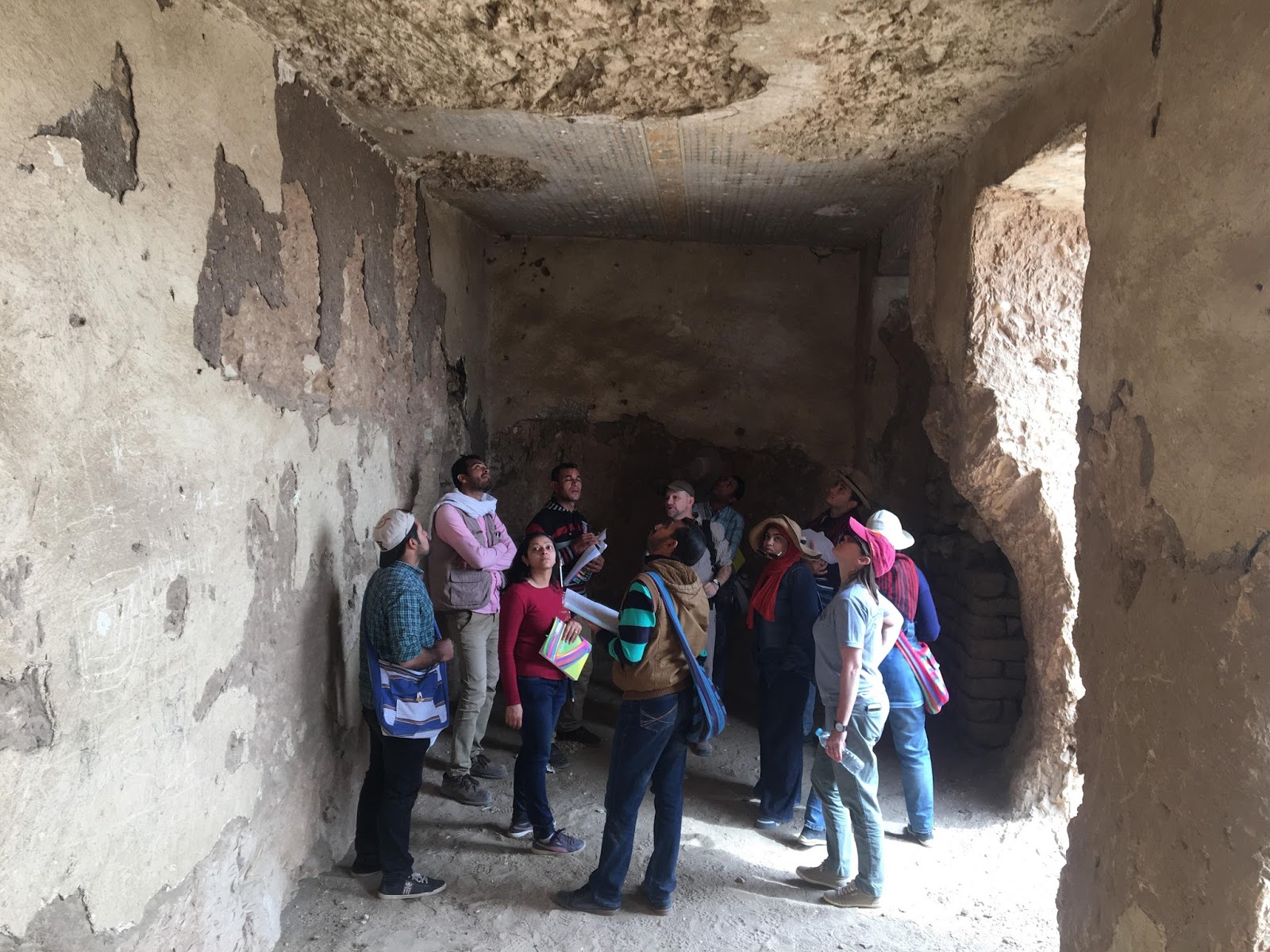
Examining the ceiling of TT83

Group shot in front of Useramun's upper tomb, TT 61 

Discussing Useramun's lower tomb, TT 131

We finished the first week exhausted but satisfied with all we had accomplished, and celebrated by having lunch and a cold beer at Sheikh Ali / Marsam. We also took this time to have a staff meeting with Yaser, Sayed, and Hazem, reviewing the first complete week of teaching to see if there were any concerns, issues, or suggestions, and also examining all the students’ notebooks. We were very pleased with how the notebooks looked, and the quality and organization of the note taking. Many included drawings and sketches to help them visualize points mentioned in lecture by both JJ and Will, and took notes in Arabic to keep up, while in the evenings re-writing and annotating what they had learned. It was certainly clear that all of the students were understanding and following the teaching instruction and taking our advice about treating the notebooks seriously and using them as a study aid. Staff meeting and lunch finished, we headed home to rest before spending the evening at Casa Italia on the west bank at a party organized by Francesco. Eugene and Piet joined us, and it was a lovely time spent chatting and catching up with colleagues and friends.

Friday, February 9, 2018

2018 Pre-Field School "Prep Week"

After just over a 2 month break for the holidays, Mr. Will and I rendezvoused at Heathrow on Feb. 5 for the direct flight via Egypt Air to Luxor. As serendipity would have it we met in the queue to check in, and miraculously none of our luggage was overweight (despite all the archaeological equipment JJ was carrying). Obviously, the gods are smiling on this trip. Lunching in the same restaurant where we have met in the past, we caught each other up on recent events, including the Philadelphia Eagles upset victory over the New England Patriots, which JJ was forced to miss due to flying to London! Bad to miss the game, but good that Philly won! The flight was pleasantly uneventful and on-time, arriving in Luxor just after 10pm local time. We were met by not only Hazem and our driver Ayman, but Sayed also was there to welcome us back. Those of you who have followed us before will be familiar with both Hazem, as Project Manager, and Sayed, our Epigraphy Assistant. As our flat was not quite ready, we went to Hazem’s house, where upon arrival we were warmly greeted and given a meal and a bed for the night.

Tuesday morning, after coffee and breakfast, we (including Hazem) headed to the west bank for our first round of teftish visits in order to sort out the necessary paperwork to begin the field school. We met Sayed at the teftish and were welcomed by our old friend Mr. Ramadan Ahmed, Director of Foreign Missions Office on the West Bank, who instigated the required procedures. When we entered the office we were delighted to see Sayed’s wife, Safaa, and even more thrilled to learn she would be our inspector for the season! Our former student Abd el-Ghany also appeared so we had a chance to catch up with him as well. After leaving Safaa to sort our permissions with Ramadan, we were ushered into Dr. Fathy Yassin’s office, the General Director of Antiquities on the West Bank, for the final approval for the project to start. Whilst there, as is so often the case, who should walk in but a blast from the past for Mr. Will. Friend and colleague from the Giza Field School Dr. Afifi Rohim, as well as a former student, Eltayeb Mohamed Khudary, neither of whom Will had seen in years! We subsequently found out that they are both part of the Western Valley Excavation project of Dr. Zahi Hawass, and Afifi is the Field Director. Permissions acquired, and stamp of approval given, we adjourned to the garden of Sheikh Ali for the first masbut of the season and to discuss with Sayed and Hazem some of the plans for the beginning of the work. As those of who have followed us will know, Sheikh Ali is the place where Egyptologists run into other Egyptologists, so we were not surprised that the cool-looking dude with the sunglasses coming across to greet us was none other than old friend, and now Director of IFAO (the French Institute in Cairo), Laurent Bavay, who is in Luxor checking in on the work of the French at Deir el-Medina, and in Theban Tomb 96.


Masbuts drunk, we headed back east thinking we might be able to visit the Karnak teftish in order to fill out the necessary paperwork for using the Karnak Lab, but finding that the Director was absent, we opted to have a lemoon at Oasis Palace instead. However, this allowed us to meet up with Yaser, who had secured the permissions for all of the students to attend the field school. Oasis Palace has become something of a haunt for Egyptologists, not just us, as it was to prove today when who should walk in just as we were finishing our meeting, but Francesco Tiradretti, Director of the Italian MIssion at the Tomb of Harwa (TT37). He was as thrilled to see us as we were to see him, and almost immediately extended the invitation to have pizza with his team at Casa Italia, his dig house on the west bank. Naturally, we accepted on the spot, learning that our seasons would happily overlap.

Lemoons finished, we bade farewell to Yaser and headed to Hazem’s for the planned family meal. It was delightful to see his sister Noha and her twin boys Bara’a and Bilal, now 10 months old, as well as Ahlam’s husband Abdullah, both of whom joined us for dinner. Hazem’s borther Ahmed was unable to east with us as he was directing the building works still progressing outside as the family is extending the house upwards to accommodate extra floors for when the sons marry, a long-standing tradition in Egypt. Hopefully there will be another opportunity before he heads to Cairo. The food, which Hazem’s mother had prepared, was absolutely delicious and included many of our favorites. Comfortably full we packed our bags and moved into the newly cleaned and readied flat belonging to Dr. Betsy Bryan, where we have stayed in past years. After unpacking and settling in, we realized the “exertion” had worked up an appetite and we were getting hungry again. It has been at least 3 hours, and as so many of you will remember, we need to eat every 3-4 hours! Aware of an empty refrigerator, Will suggested that the obvious solution was to go to our standby, Pizza Roma, for dinner and a beer to celebrate our return. All in one day we managed to touch base with 3 of our favorite watering holes, which even for us is something of a record!

Wednesday we headed to Karnak to take care of business with Dr. Mostafa el-Sogheir, and get everything prepared to begin teaching in the Karnak Lab on Saturday. Naturally, we ran into yet another friend and former student, Saad Bakhit, who you will recall was our Inspector at Karnak for the digital field school last fall. While our papers were being processed who should walk into the office but one of our new students who is an Inspector at Karnak and was bringing Dr. Irmgard Hein in to finish her permissions. Irmgard is an old friend of Will’s (of course!), and there was much general rejoicing in seeing one another so unexpectedly after so many years. As it proved, she is there to photograph objects stored in the magazine located at the Montu Temple, and hopefully there will more opportunities to see each other while we are teaching in the lab. After finishing up at Karnak, and meeting our Inspector Ali Erfan, we headed for the shops – Aboudy to do a bit of book browsing and Ragab for some more food items. By then we were hungry (again) and headed to our standard – Oasis Palace – for our first lunch of the season. The afternoon was spent working on the planned teaching program for the first week, as we needed to review and perhaps revise what we had taught 2 years ago. Happily, it turned out not to need too much tweaking!

Thursday we planned to spend the morning making sure everything was set up and the tomb was ready for the students. We got a later than usual start, awaiting Hazem to wind up some family business before heading to the west bank, which meant a decadently late arrival at TT110, just in time for tea and second breakfast. When we arrived, not only were our Inspector Safaa and Sayed already at the site, but also our former student Alaa. Much hugging and general rejoicing ensued at the reunion! We had just finished second breakfast only to find out that Hazem had forgotten not only the tea, but also the chato biscuits! Since he had already forgotten (twice!) to deliver the bag of shoes and work materials we had left behind, this amounted to 3 strikes against Hazem and so the team voted to enact the first harama of the season. As many of you will remember, the significance of haram in Egypt entails that when a mistake is made a compensation much be provided to the victim. In this case the entire team, which we counted as 9 people at breakfast! The decision as to the penalty was given by Abu Hamada seeing as he was the individual who had to beg tea from the gafirs at a neighboring guard’s hut. The result – cake and cola for everyone! Safaa insisted that it come from a particularly nice bakery – La Voche – so that Hazem could not cheat by providing a stale slab of sponge cake. Instead, as the name implies, we had fine Parisian patisserie, Egyptian-style, cake enveloped in whipped cream along with cold coke and fanta for the end of the workday.


We had been invited to Sayed and Safaa’s for lunch after the work, but seeing as we had finished early, and both Hazem and JJ had a lot of work to do, it was decided that we would return early and return back to the west around 3, giving Sayed and Safaa extra time to prepare the meal as well. In the end Hazem was unable to join us as he was still collating handouts for the students, but JJ and Will enjoyed a marvelous feast of duck, Egyptian fried chicken, and a vegetable and meat tagine, all dishes that we had been treated to at their house last year. We spent a lovely couple of hours eating, talking, and getting reacquainted with their two daughters, Jana, now 4, and Malak, nearly 1 year old. The rest of the day was spent back at the flat with JJ finishing up her lecture preparations while Will learned further features of his new computer. And of course, JJ followed the Eagles victory parade through Philadelphia in real-time on her computer and through facetiming with Raphael and the boys.

Friday morning we spent working, as we have done in the past, at Chicago House, this time by preparing for when we bring the new students to the library. We were welcomed by the librarian Anait Helmholz, who generously offered to be available to introduce our students to the use of the library. And our good friend Ellie Smith offered, once again, to show the students the Chicago House photo archive. Artists Jay Heidel and Krisztián Verteś were likewise willing once again to let us and our students impose upon their hospitality and visit their work in the Luxor Temple. As in the past, so many friends and colleagues have offered their time in order to enrich the experience of our students in the field school. We once again enjoyed lunching at Chicago House and meeting old as well as new friends. It was particularly nice to see Susan Allen, who is part of the Metropolitan Museum Malqata Team, and whom we had not seen in Egypt in years. And, naturally, Will ran into former students from his time teaching in the AERA field schools at Giza.

We managed to finish at Chicago House just in time to meet several of our former students who we have invited to participate in an object and pottery drawing field school taught by Yaser: Nadia, Mahmoud, Abu el-Hagag, and Sayed el-Rekaby from last season, as well as Alaa from our first season. This gave us an opportunity to try out a newly opened café situated along the banks of the Nile halfway between Chicago House and Karnak, aptly named Marina Café. We sat outside enjoying the view and catching up, and Yaser was able to present his teaching program to everyone. The inevitable group photo followed and in exchange for the waiter taking the photo, the manager had us hold the restaurant’s menus. So don’t blame us for the corporate promotion!


Abu el-Hagag, Mahmoud, Sayed, Yaser, Will, 
JJ, Nadia, Alaa, Sayed el-Rekaby, Hazem


We raced from one venue to the next, needing to be at Hazem’s by 6 to prepare for the dinner with the new students. It was a chance to introduce ourselves more formally to the students and give them at least an inkling of what they had been accepted into as far as the program was concerned. This was held upstairs in Hazem’s house, and then we adjourned to the downstairs dining area for the meal spread out on the floor in customary Egyptian fashion. As in previous seasons, Hazem’s mom outdid herself with the marvelous spread of traditional Egyptian cuisine, and as in prior years our students proved equal to the task of consuming at least most of it, in what seemed to us record time. We subsequently returned upstairs to continue with more discussion about the upcoming school. Yaser presented his plans for his portion of the field school, teaching the students object and pottery illustration, and Hazem clarified the logistics of transport, etc., for the students’ respective commutes the following morning. All of the business concluded, we were finally able to descend upon the cake and tea to round off our first session with the new students. A group photo followed, and we bid farewell to our students for the evening.


Amira, Rehab, Rasha, Hala

Walid, Yaser, Alaa Talaat, Hussein, Mena (Mario), Mahmoud


Back Row: Amira Abdel Koudos Fahim, Rehab Sabry Shazly, Rasha Ahmed Hany Mohamed, Hala Ahmed Mohamed Elsamman, Mudira JJ, Mr. Will, Alaa Talaat Shams El-Din Mohamed, Hussein Ahmed Hussein Hofny, Mahmoud Abdel Wahab Mohamed Abdel Nour

Front Row: Walid Elsayed Abd el-Raheem, Hazem Shared, Sayed Mamdouh, Mena (Mario) Fahim Rezk

Photographer: Yaser Mahmoud


Watch this space to see what ensued the following morning …